European resistance to US foreign policy over the decades

As European countries reject Trump’s call for help to reopen strait of Hormuz, a look back at previous tensions between the western allies
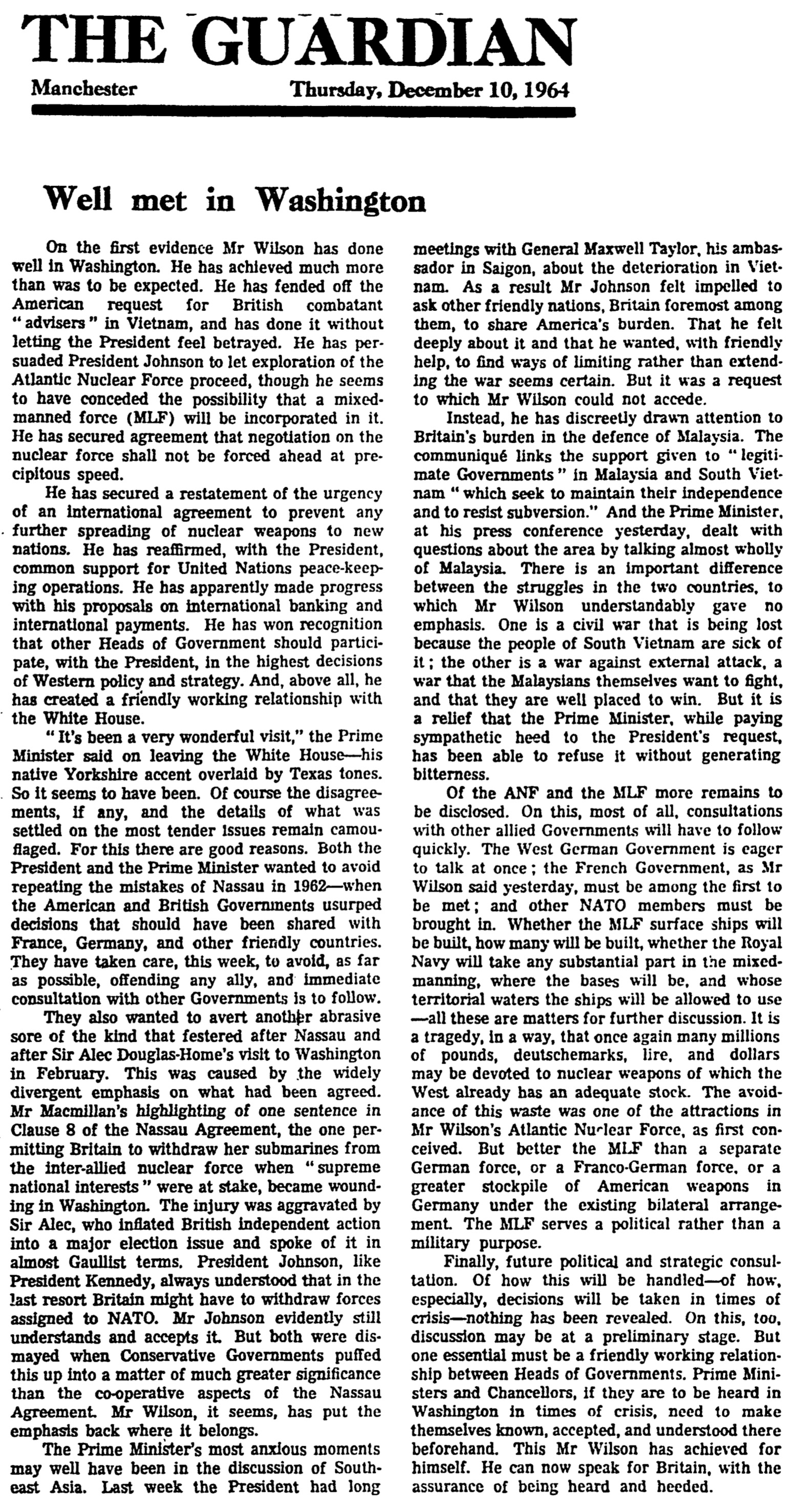
Mr Wilson in role of strategic salesman
PM turns down President Johnson’s request to send UK forces to Vietnam
From Ian Aitken
10 December 1964
One success Mr Wilson can report [from first meeting with the US president] relates to the anticipated American demand for a British contribution to the war in South Vietnam. Mr Wilson appears to have convinced President Johnson that Britain is already making a contribution to the defence of Malaysia which is comparable in size and cost to the American effort in South Vietnam. He produced the figures of Britain’s military commitment in Malaysia, reminding President Johnson that Britain already has 8,000 troops in Borneo and a total of 20,000 in Malaysia as a whole. This is exactly comparable to the 20,000 US “advisers” who are operating in Vietnam. Mr Wilson also appears to have convinced President Johnson of the magnitude of the contribution Britain can make to the defence of India in the transformed situation created by the explosion of a Chinese nuclear device. Mr Wilson was able to tell President Johnson that there is a mounting demand in India for an Indian nuclear weapons’ programme to counter the Chinese device.
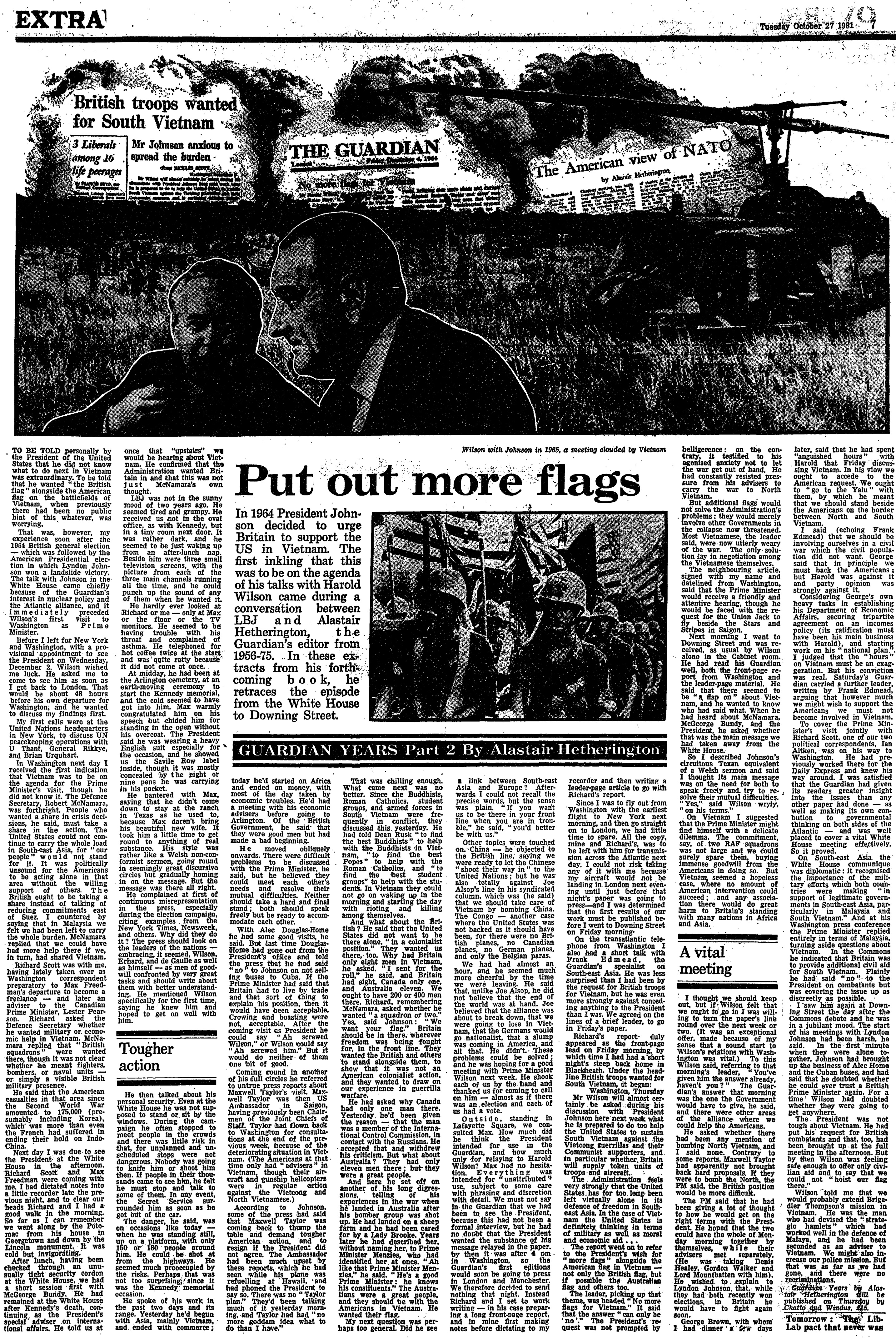
Editorial: Well met in Washington
10 December 1964
Last week the president had long meetings with Gen Maxwell Taylor, his ambassador in Vietnam about the deterioration in Vietnam. As a result Mr Johnson felt impelled to ask other friendly nations, Britain foremost among them, to share America’s burden. But it was a request to which Mr Wilson could not accede.
Read the full article.
Letters to the editor
From Sir Harold Wilson MP
29 October 1981
Sir, the extract referring to Alastair Hetherington’s forthcoming book is accurate in every detail. To underline his account of President Johnson’s repeated pressures – sometimes in 2am telephone calls – I would cite the president’s almost pathetic request that Britain should send six Highlanders in kilts with bagpipes to Vietnam. They were not sent.
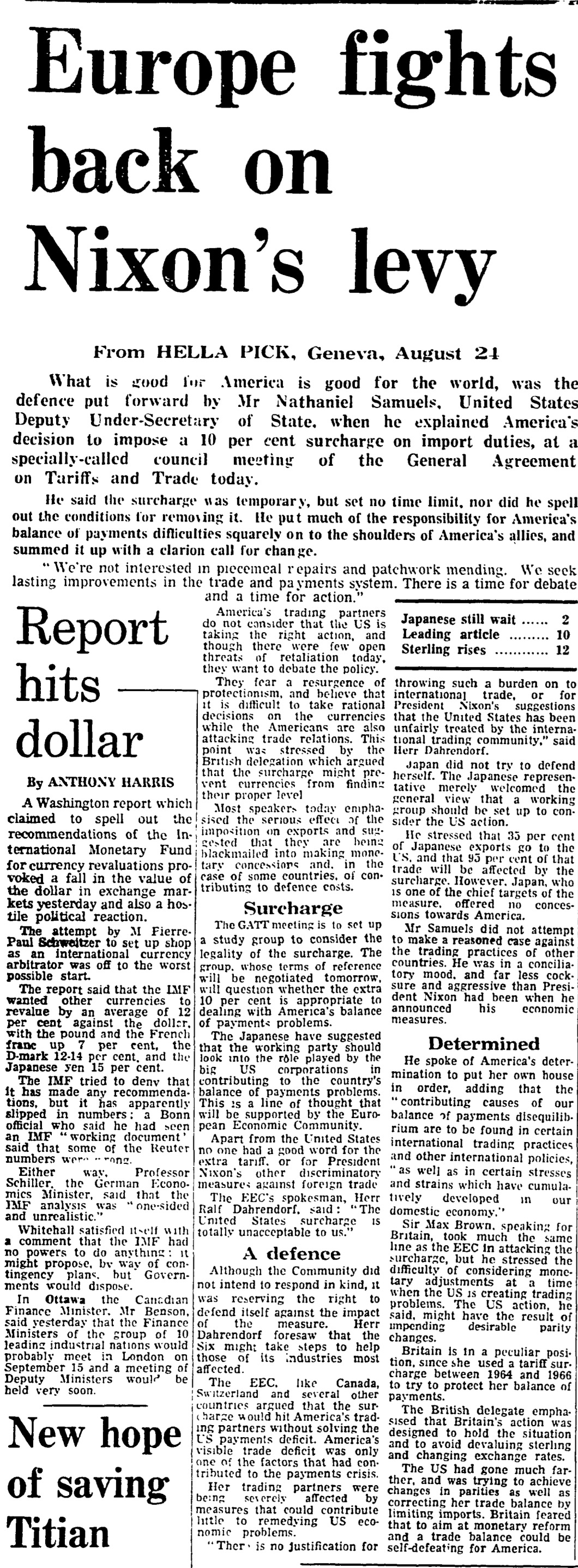
Europe fights back on Nixon’s levy
From Hella Pick, Geneva
25 August 1971
What is good for America is good for the world, was the defence put forward by Mr Nathaniel Samuels, United States deputy under-secretary of state, when he explained America’s decision to impose a 10 per cent surcharge on import duties, at a specially called council meeting of the General Agreement on Tariffs and Trade today. He said the surcharge was temporary, but set no time limit, nor did he spell out the conditions for removing it. He put much of the responsibility for America’s balance of payments difficulties squarely on to the shoulders of America’s allies, and summed it up with a clarion call for change. “We’re not interested in piecemeal repairs and patchwork mending. We seek lasting improvements in the trade and payments system. There is a time for debate and a time for action.”
Apart from the United States no one had a good word for the extra tariff, or for President Nixon’s other discriminatory measures against foreign trade. The EEC’s spokesman, Herr Ralf Dahrendorf, said: “The United States surcharge is totally unacceptable to us.”
Although the Community did not intend to respond in kind, it was reserving the right to defend itself against the impact of the measure. Herr Dahrendorf foresaw that the Six might take steps to help those of its industries most affected. The EEC, like Canada, Switzerland and several other countries argued that the surcharge would hit America’s trading partners without solving the US payments deficit.
Read the article in full.
US fails to halt flow of Siberian gas to Germany
28 July 1981
The biggest East-West trade deal in history, a project to pipe Siberian natural gas to western Europe, looks likely to be concluded soon, despite serious misgivings by the US government.
EEC hits back at ban on pipeline
13 August 1982
Brussels: The EEC told Washington yesterday that its ban on European firms using US technology in building the Soviet pipeline was illegal under international law. It added that the embargo apparently violated US law, harmed European business interests at a time of economic recession, and would cause no delays in completion of the pipeline.
In a document, given to US officials in Washington, the EEC said the effect on Europe of the ban was “unquestionable and seriously damaging.” The Commission prepared the paper after the Reagan Administration extended its ban on US firms taking part in the pipeline project to include European companies building pipeline parts under US licences. The document called the US move “unacceptable interference in the independent commercial policy of the European Community.” The EEC based its objections on legal and economic grounds.
The pipeline, due to become operational in 1984, will pump up to 40 billion cubic yards of natural gas from Siberia to several west European countries. The US embargo affects companies in Britain, Italy, France and West Germany.
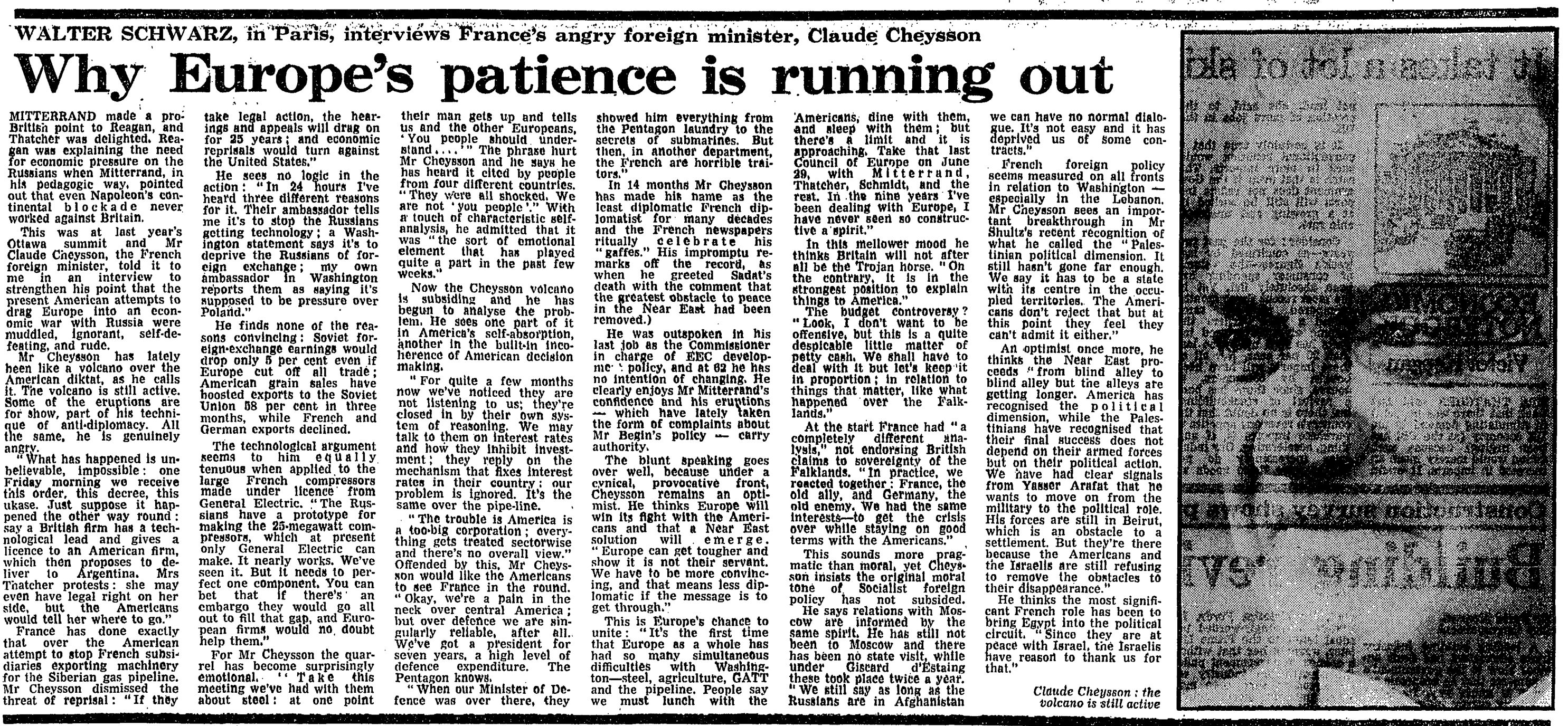
See also: Why Europe’s patience is running out.
Wimps, weasels and monkeys – the US media view of ‘perfidious France’
By Gary Younge in New York and Jon Henley in Paris.
11 February 2003
The “petulant prima donna of realpolitik” is leading the “axis of weasels”, in “a chorus of cowards”. It is an unholy alliance of “wimps” and ingrates which includes one country that is little more than a “mini-me minion”, another that is in league with Cuba and Libya, with a bunch of “cheese-eating surrender monkeys“ at the helm.
Welcome to Europe, as viewed through the eyes of American commentators and newspapers yesterday, as Euro-bashing, and particularly anti-French sentiment, reached new heights. In a barrage of insults and invective which ranged from the basest tabloid rants to the loftiest columnists on the most respected newspapers, European-led resistance to America’s war plans in Iraq was portrayed not as a diplomatic position to be negotiated as a genetic weakness in the European mindset which makes them reluctant to fight wars and incapable of winning them.
The front page of Rupert Murdoch’s New York Post yesterday shows the graves of Normandy with the headline: “They died for France but France has forgotten.” “Where are the French now, as Americans prepare to put their soldiers on the line to fight today’s Hitler, Saddam Hussein?” asks the pugnacious columnist Steve Dunleavy. “Talking appeasement. Wimping out. How can they have forgotten?” A cartoon in the same paper shows an ostrich with its head in the sand below the words: “The national bird of France.”
Continue reading. See also: Europe old and new.